
Successful decision-making starts with curiosity Photo by Sebastian Knoll on Unsplash Hello, it’s me. The person who bogs down the mee...
Successful decision-making starts with curiosity

Hello, it’s me. The person who bogs down the meeting and won’t answer any questions before dropping her patented line, “What problem are we trying to solve?” You roll your eyes. This again.
Am I annoying? Yes, often. But I’m also guiding us all into an important mental model: second-order thinking. When you harness the power of second-order thinking, it becomes impossible to suggest an impulsive solution without first considering — how did we get here?
Shifting the way you consider the consequences of your decisions will improve the quality of your ideas and the impact of your decisions. Plus, you look smart as hell.

First-Order Thinking: The Fastest Way to a Bad Decision
First-order thinking is simplistic, superficial, and lacks foresight. And we all do it.
We want to identify the solution to our problem, and if one is present, we often grab onto it without thinking past the immediate gratification of “closing” the problem. First-order thinking is how you end up with temporary and non-sustainable solutions.
Instant gratification is understandably tempting. We want to fulfill our desires without delay, but it often means we forgo future benefits that could outweigh what we claim at the moment.
Humans notoriously also want to be right… so it makes sense that we often choose the first “most obvious” solution for our problems. We want to have the right answer, right now, and move forward.
However, understanding the history and future consequences of the problem we’re considering is crucial for informed decision-making.
“Failing to consider second- and third-order consequences is the cause of a lot of painfully bad decisions, and it is especially deadly when the first inferior option confirms your own biases. Never seize on the first available option, no matter how good it seems, before you’ve asked questions and explored.” — Ray Dalio
Common Decision-Making Biases and Fallacies
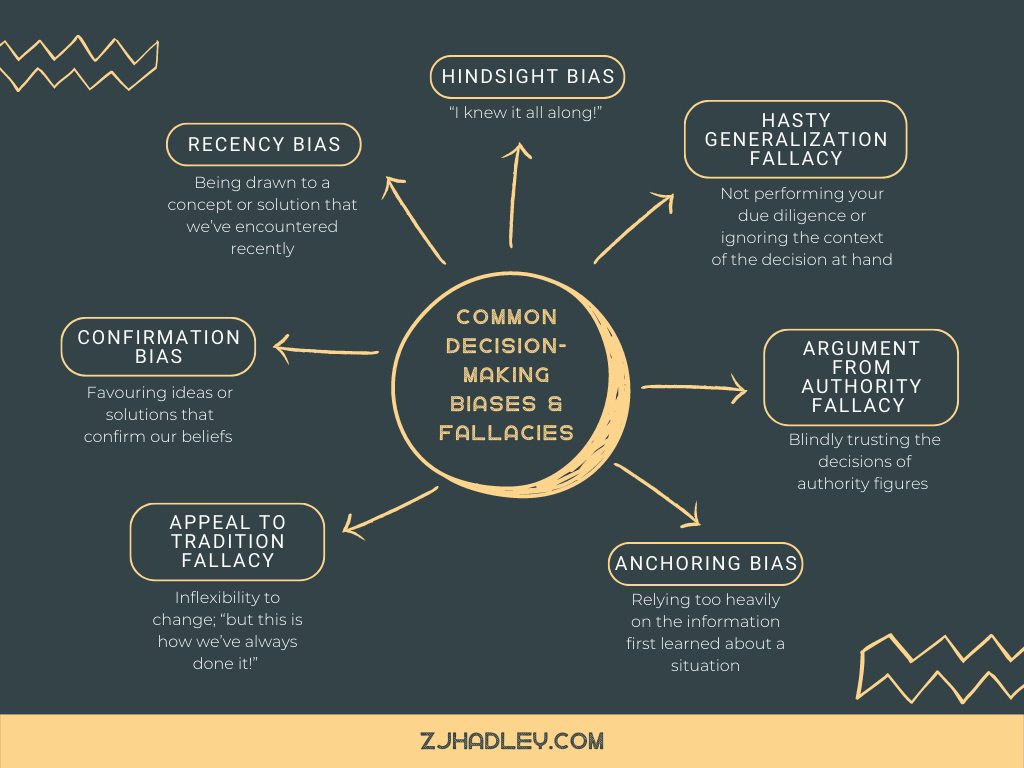
Mental Models: Brain Shortcuts You Can Practice
Today’s environments are complex. We’re constantly intaking, sorting, and processing massive amounts of data at every waking moment. Folks in 2011 processed 5x more information daily than their counterparts in 1986, and it’s safe to assume we’re intaking even more today. (Thanks, internet!) And that’s just ambient information, so we’re processing even more when we’re focusing on a specific problem.
Faced with this overload, our minds subconsciously seek patterns and latch onto the path of least resistance, although that process may not lead us to the ideal solution. We all have our own lived experiences and biases, which impact how we work through problem-solving and decision-making.
The world is layered, complex, and often convoluted. No wonder we need a way to ease the burden of understanding our surroundings and scenarios. Enter mental models, heuristics, and intimidating phrases that simply mean “brain shortcuts.”
The good news is mental models can be honed and developed. Cognitive biases and logical fallacies lose their influence when we learn to identify how they impact our thought processes.

Chesterton’s Fence: Why Is This Fence Here?
Chesterton’s Fence is a mental model that encourages thinkers to discover why something was built before dismantling it. The decisions that came before you were made for a reason, and it’s important to understand why that particular decision was made and how it came to be.
Fences aren’t built just for kicks. They’re put there for a reason.
It’s a tale as old as time… a new executive enters the scene hellbent on proving their impact in The First 90 Days, immediately disassembling existing frameworks the old guard set up. However, too many of these ambitious changes fail — because the reasoning behind the current processes was not explored nor understood.
Change can drive progress, that’s for sure, but not without a holistic consideration of why and how the current environment was developed. Things are the way they are for a reason, which must be explored to understand the impact of charging toward change.
Please note: Chesterton’s Fence is not about maintaining the status quo; it’s about ensuring you have all relevant information before making a decision.
Be curious and ask questions about what brought you to the moment you’re in.
- Has your solution been attempted?
- What prompted the development of the current solution?
- What constraints impacted the initial decision?
- Who was impacted, and how will a change impact current team members?
Remember, your solution is only as good as the foundation it’s built upon, and those who don’t study history are doomed to repeat it.
Consider the Consequences of the Consequences
Chesterton’s Fence is about understanding relevant history, and second-order thinking is about exploring future implications.
The two, in tandem, improve your decision-making skills and build gravitas.
Second-order thinking is considering the consequences and impact of your decision beyond the immediate result. Simply put, it’s asking “… and then what?” after coming to an initial conclusion.
When practicing second-order thinking, you consider the initial consequences and each possible consequence thereafter.
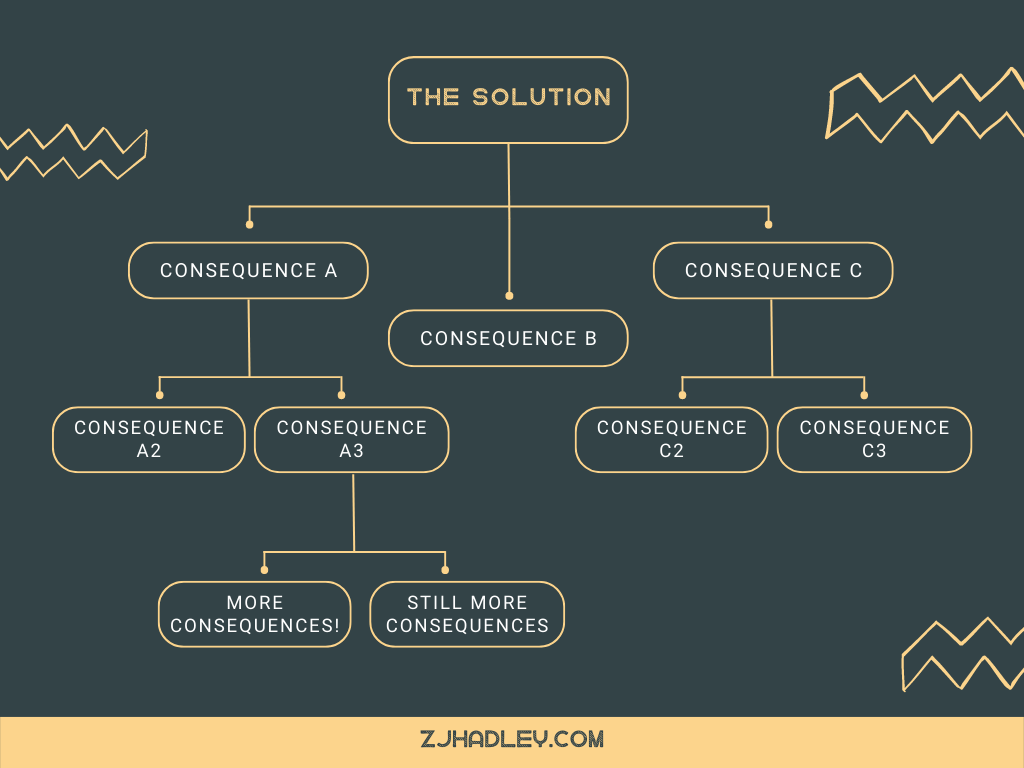
Think of every decision as a stone being tossed into a pond. There are inevitably ripples, not just a splash. Each ripple is a consequence, and they build upon each other as they spread out in multiple directions.
The point is: your decision or solution can have long-term impacts that you may not have considered before.
That’s why curiosity is an important quality for second-order thinking and beneficial decision-making.
When we’re younger, there is wonder in every encounter, partially because we are aware of how much we don’t know. That’s why little kids love asking questions and following up with a series of “why?” to every explanation. We crave holistic understanding.
Curiosity is a quality deeply linked to intelligence because it activates and strengthens your mind.
Being inquisitive enables you to expand your knowledge, consider different perspectives, and thoughtfully consider variables tangential to the core issue. It’s critical for second-order thinking.
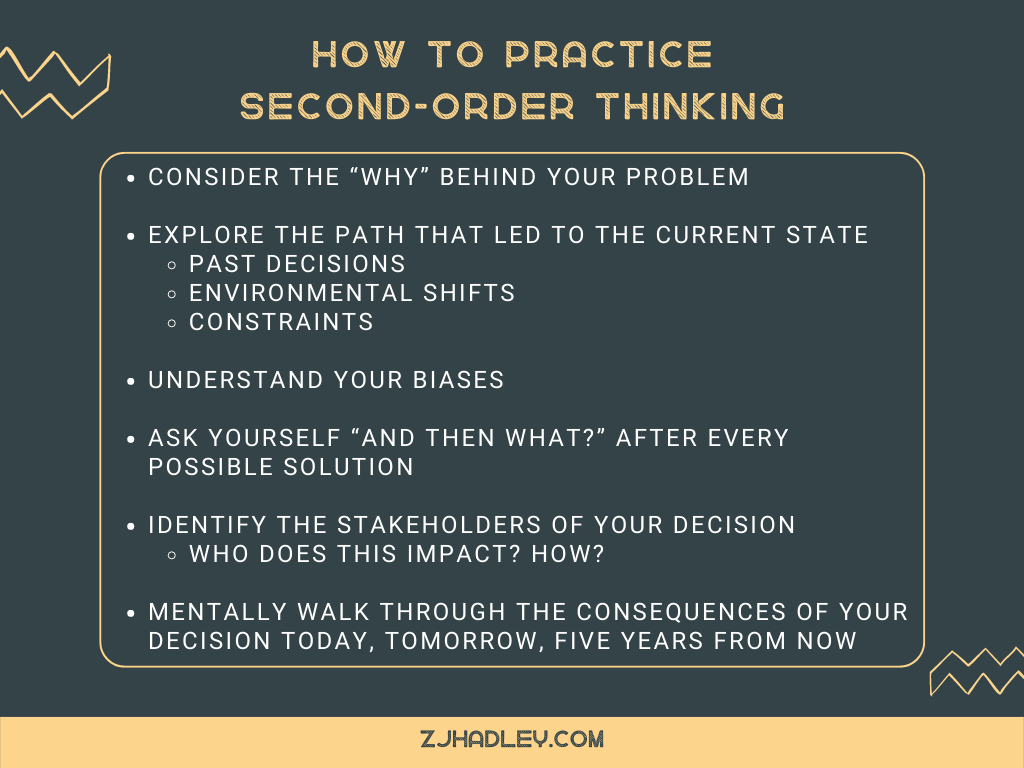
Benefits of Encouraging Second-Order Thinking on Your Team
Healthy work environment
Beyond avoiding decisions that will wreak havoc on your workplace, encouraging second-order thinking can contribute to a work environment where team members feel welcome to share and explore ideas (this is known as psychological safety).
Improved idea generation
Through practice, people at work will understand that their ideas will be approached with respect and curiosity, increasing participation. Hearing more ideas enables us to pinpoint the ideal solution.
Social capital
A team that shares respect, norms, and values will work collaboratively and effectively. Social capital is the byproduct of psychological safety and demonstrated thoughtfulness.
Improves odds of strategy success
When you carefully consider all angles of a solution, weighing both the past and present, you are more likely to identify a solution that will succeed.
Optimal conflict resolution
Developing second-order thinking is especially beneficial for conflict resolution. Weighing a conflict solution’s benefits, costs, and social implications is much easier when you account for relevant history and subsequent consequences.
Be the smart person in the meeting
Follow me on LinkedIn for more human-centered career insights, and share this with your team!
Additional Resources
- How Successful Leaders Think
- Why It’s So Hard To Pay Attention, Explained By Science
- Mental Models: The Ultimate Guide
- Mental Models: The Best Way to Make Intelligent Decisions
- Second-Order Thinking: What Smart People Use to Outperform
- Chesterton’s Fence: A Lesson in Second-Order Thinking
- The Psychology of Instant Gratification and How It Will Revolutionize Your Marketing Approach
- 7 Logical Fallacies That Can Harm Your Decision Making
Be Smarter: A Crash Course in Second-Order Thinking was originally published in Better Programming on Medium, where people are continuing the conversation by highlighting and responding to this story.


No comments
Note: Only a member of this blog may post a comment.